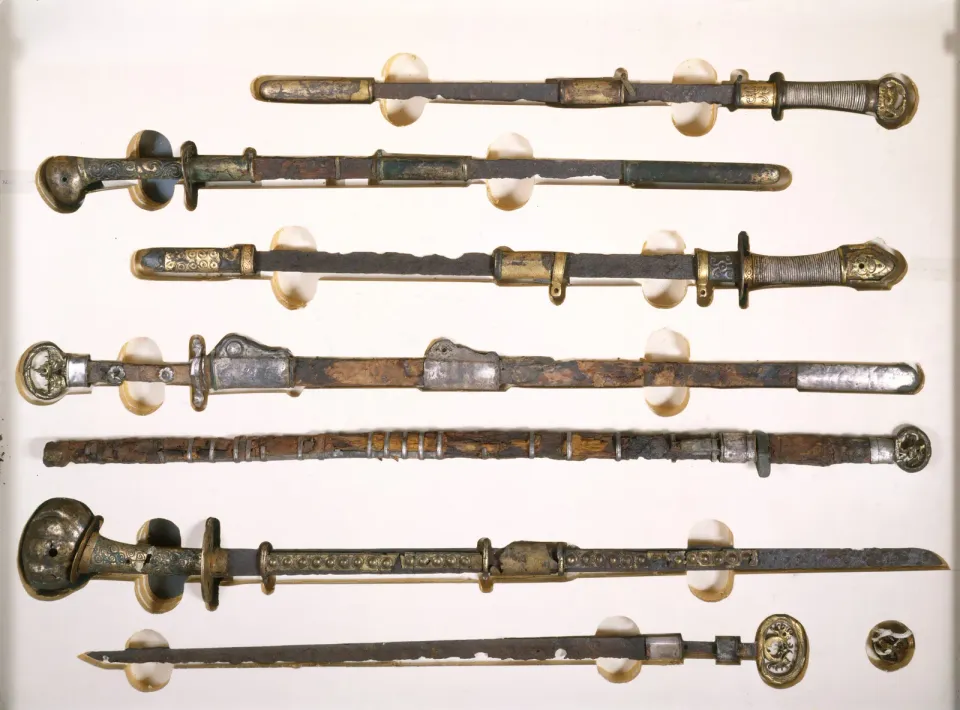
Japanese
Kusanagi-no-Tsurugi
草薙剣 (Kusanagi-no-Tsurugi)
Cuts the grass by itself and turns back fire.
WeaponFirst recorded 712
Loading artifact…
Photograph: A Noh costume, a choken, from the Edo period, about 1800–1850. The loosely woven reddish silk robe is spread out on a pole, woven in gold and colored threads with hanging wisteria and fans.
Focus the photograph, then use the arrow keys to pan and the plus and minus keys to zoom. The buttons at the lower left also move it. Press a numbered button on the photograph to zoom to that note.
羽衣
Wearing it, one can fly up and return to heaven.
According to the Tango no Kuni Fudoki, long ago eight heavenly maidens came down to bathe in the Manai spring on the summit of Mount Hiji. An old couple secretly hid one maiden's feather robe, and without it she could not return to heaven and became their daughter. The sake she brewed cured any illness and the old couple grew rich, but after ten years or so they drove her out.
The most famous version is the Noh play Hagoromo. The fisherman Hakuryo finds a beautiful robe hanging on a pine in the pine grove of Miho. When a heavenly maiden appears and weeps that without it she cannot return to heaven, he says he will give it back if she shows him a heavenly dance. When he suspects she will fly away without dancing if he returns it first, she answers, "Doubt belongs to the human world; in heaven there is no deceit."
Ashamed, the fisherman returns the robe, and the maiden puts it on, dances and vanishes into the sky beyond Mount Fuji. Stories of capturing a heavenly maiden by hiding her feather robe are told all over the world, including the Korean tale "The Fairy and the Woodcutter."
The photograph shows Noh Costume (Chōken)(Japan, Edo period (1615–1868), 1800–1850), a real museum object that evokes the legendary artifact.
草薙剣 (Kusanagi-no-Tsurugi)
Cuts the grass by itself and turns back fire.
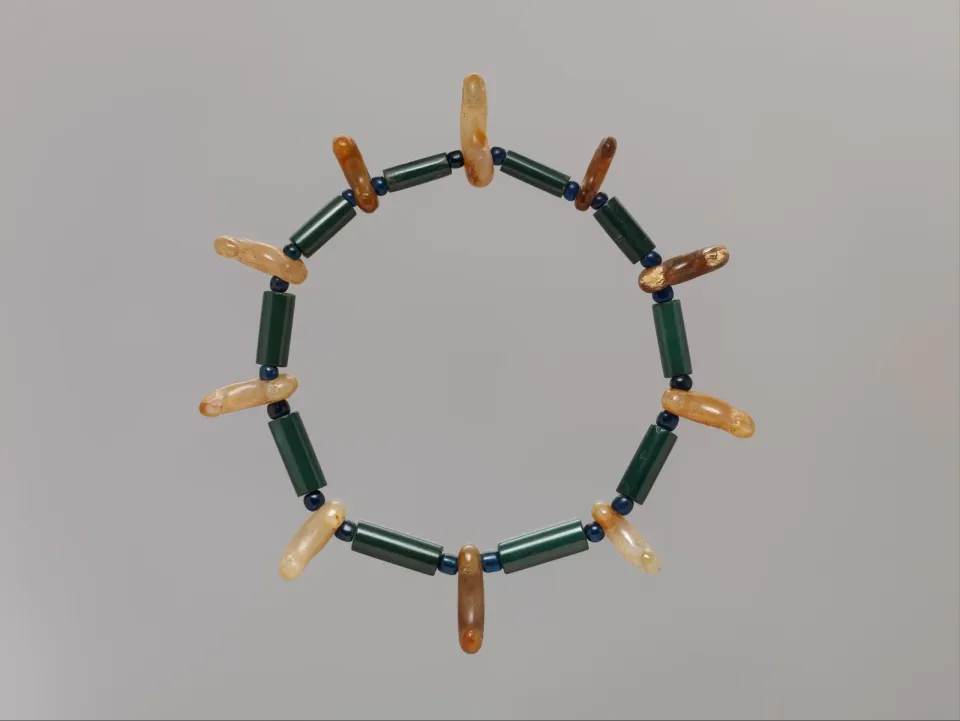
八尺瓊勾玉
One of the three sacred treasures, holding the spirit of the gods and the legitimacy of the imperial line.
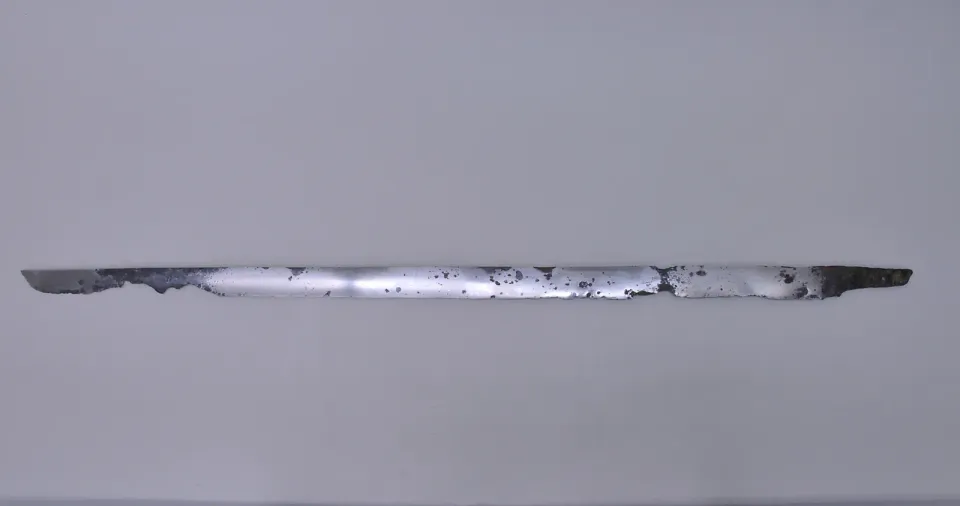
十拳剣
A great sword ten fists long, which cut the eight-headed serpent to pieces.
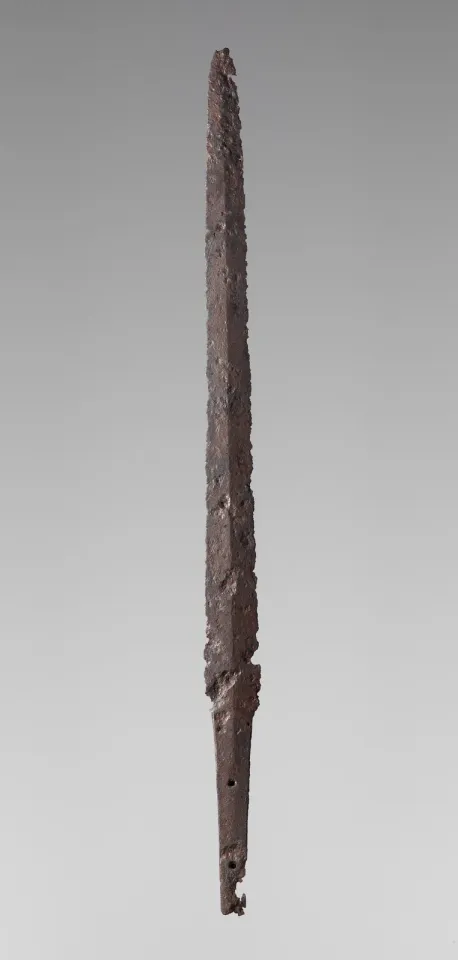
布都御魂
A single stroke revived soldiers felled by poisonous vapors.