Indian
Soma
Soma
The hymns sing that whoever drinks it is filled with strength and inspiration and becomes immortal.
ElixirFirst recorded c. 1200 BCE
Loading artifact…
Photograph: A page from a Ramayana painted in Malwa, central India, about 1650: Rama, Sita and Lakshmana visit the hermitage of the sage Bharadvaja. Against a red ground, blue-skinned Rama, holding a bow, bows with his companions to the sage; the yellow-doored hermitage is at right, trees above.
Focus the photograph, then use the arrow keys to pan and the plus and minus keys to zoom. The buttons at the lower left also move it. Press a numbered button on the photograph to zoom to that note.
Śārṅga
The bow of Vishnu, which only his avatar could string.
In Indian myth, Vishnu the Preserver bears the bow Sharanga, along with the discus Sudarshana, the mace Kaumodaki and the conch Panchajanya. The Mahabharata repeatedly calls Krishna, Vishnu's avatar, 'the bearer of Sharanga.'
In the Ramayana, Rama, another avatar of Vishnu, breaks the bow of Shiva and marries Sita, and then meets the angry Parashurama, the sage of the axe. When Parashurama holds out the bow of Vishnu and challenges him to string it, Rama strings it with ease. Parashurama recognizes that Rama is Vishnu and withdraws.
The name Sharanga is sometimes interpreted as 'made of horn.' The composite bow, built of layered horn and wood, was the most powerful bow of the ancient world.
The photograph shows Rama, Sita, and Lakshmana visit the hermitage of the sage Bharadvaja at Prayaga, from Chapter 48 of the Ayodhya Kanda (Book of Ayodhya) of a Ramayana (Rama’s Journey)(Central India, Malwa Region, Madhya Pradesh, c. 1650), a real museum object that evokes the legendary artifact.
Soma
The hymns sing that whoever drinks it is filled with strength and inspiration and becomes immortal.
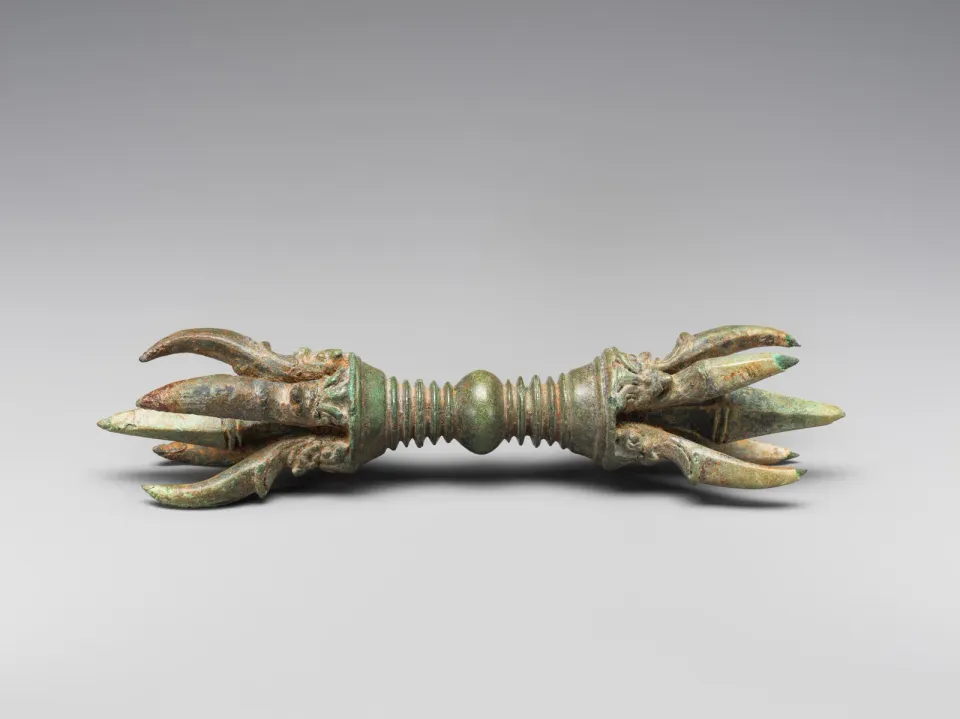
Vajra (वज्र)
Unbreakable as diamond and striking like lightning. It slew Vritra, the serpent of drought.
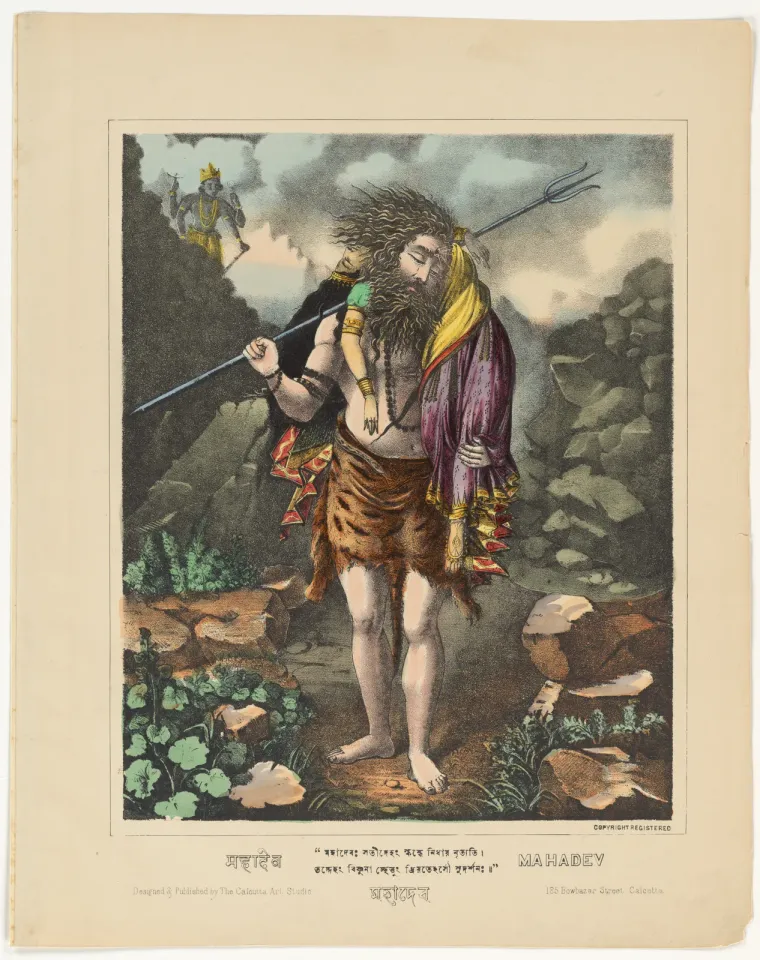
Trishula (त्रिशूल)
Its three prongs govern creation, preservation and destruction, or past, present and future.