Greek
Aegis
Aegis (Αἰγίς)
Shaken, it raises storms and sends enemy armies fleeing in terror.
ArmorFirst recorded c. 750 BCE
Loading artifact…
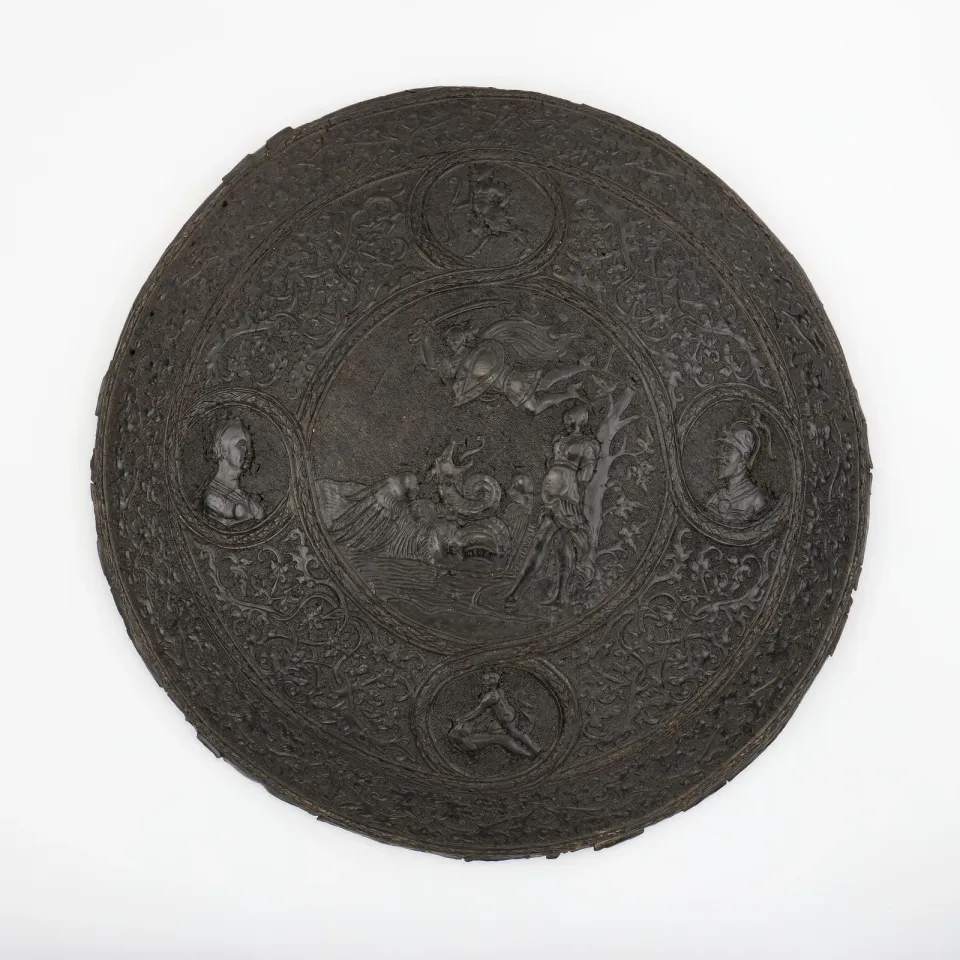
Photograph: Mars and Venus Trapped by Vulcan, an octagonal gilt-bronze relief made in Italy in the late sixteenth century by Guglielmo della Porta. Below center the lovers lie caught in a net on a couch, while the gods gather around and above to watch.
Focus the photograph, then use the arrow keys to pan and the plus and minus keys to zoom. The buttons at the lower left also move it. Press a numbered button on the photograph to zoom to that note.
Desmoi Hephaistou
Fine as a spider's web, it was invisible even to the gods, and once caught, no one could loosen or break it.
In Book 8 of the Odyssey, at a feast of the Phaeacians to which Odysseus is invited, the blind singer Demodocus sings a tale of the gods. Helios the sun, who looks down on all things, told the smith god Hephaestus that his wife Aphrodite was secretly making love with Ares, the god of war.
In his forge Hephaestus hammered out bonds as fine as a spider's web, invisible even to the gods and impossible to break, and hung them around the bed. Then he pretended to leave for the island of Lemnos. When the two lovers lay down in the bed, the net held them so fast they could not move.
When Hephaestus called the gods together, they saw the sight and burst into unquenchable laughter. Only when Poseidon, god of the sea, pledged that Ares would pay was the net loosened.
The photograph shows Mars and Venus Trapped by Vulcan(Guglielmo della Porta, late 16th century), a real museum object that evokes the legendary artifact.
Aegis (Αἰγίς)
Shaken, it raises storms and sends enemy armies fleeing in terror.
Ambrosia & Nectar
Keeps the gods ageless and deathless.
Kestos Himas (Κεστὸς ἱμάς)
Embroidered with love, longing and beguiling words, it makes anyone fall in love.