Greek
Aegis
Aegis (Αἰγίς)
Shaken, it raises storms and sends enemy armies fleeing in terror.
ArmorFirst recorded c. 750 BCE
Loading artifact…
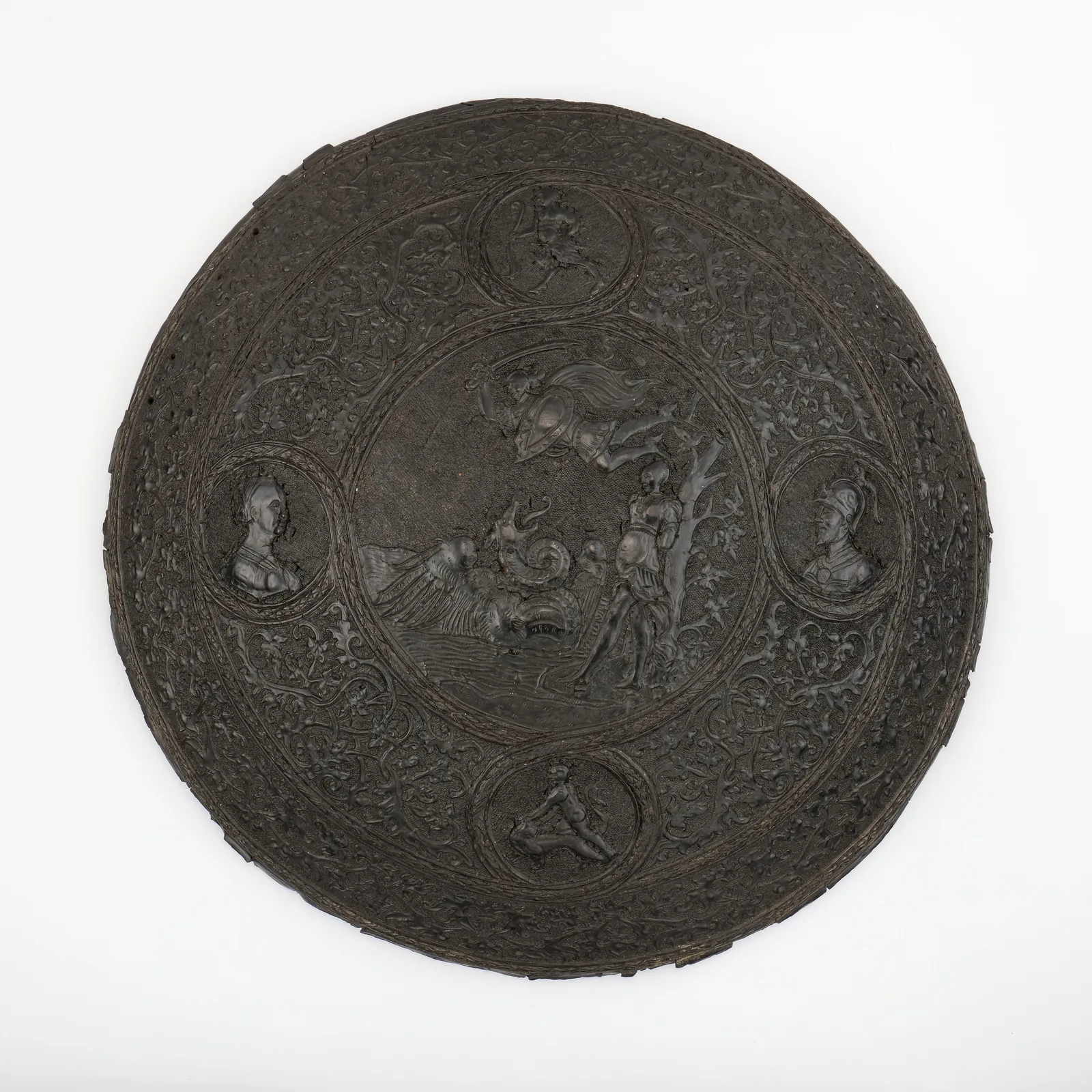
Photograph: A close view of the lower part of the steel shield of Henry II of France, about 1555. A cavalry battle fills the central oval, with figure medallions and floral relief around it and rivets along the edge.
Focus the photograph, then use the arrow keys to pan and the plus and minus keys to zoom. The buttons at the lower left also move it. Press a numbered button on the photograph to zoom to that note.
Shield of Achilles
A shield of five layers forged by a god, with the whole world engraved on its face.
When Achilles's friend Patroclus went out in his borrowed armor and fell to Hector, the armor passed into enemy hands. Seeing her son's grief, the sea goddess Thetis went to the forge of Hephaestus and asked for new arms.
Book 18 of the Iliad follows the making of the shield for more than a hundred and thirty lines. At the center are earth, sky and sea, the sun, moon and constellations. Around them a city at peace, with wedding feasts and a trial, faces a city at war, besieged and preparing an ambush.
Farmers plowing, children picking grapes, cattle attacked by lions and young people dancing in a circle follow one after another, and the river Oceanus runs around the outermost edge. Taking up the shield, Achilles returns to battle and kills Hector.
The photograph is a close view of the parade shield of Henry II of France. Scenes of cavalry combat are embossed on its steel surface and enriched with gold and silver.
The photograph shows Shield of Henry II of France (reigned 1547–59)(French, ca. 1555), a real museum object that evokes the legendary artifact.
Aegis (Αἰγίς)
Shaken, it raises storms and sends enemy armies fleeing in terror.
Ambrosia & Nectar
Keeps the gods ageless and deathless.
Kestos Himas (Κεστὸς ἱμάς)
Embroidered with love, longing and beguiling words, it makes anyone fall in love.